In short
- Reshipping fraud is real, and the person packing the boxes carries the legal risk — not the person running it.
- Every reshipping scheme has to do the same five things to work. That is what makes them recognisable, whatever the cover story is.
- One heavy signal is reason to keep asking. One decisive signal, or two heavy ones: stop and forward nothing.
- The difference is in the chain: stock arrives up front from one known shop, nothing comes from strangers, and payment runs through a ledger.
- Already in one? Forward nothing more, keep everything, and report it to the police and a national fraud desk — in that order.
- What we do not promise is set out further down, explicitly. An article that only reassures is itself a warning sign.
Search for "packing parcels from home" and almost everything you find is a warning. Consumer protection agencies, postal inspectors and police forces have all published about it, and they are right to.
Reshipping fraud is one of the oldest work-from-home scams there is. It puts the person doing the packing in legal trouble rather than the person running it. That makes the question in the title a fair one.
It deserves a real answer rather than a reassuring one. This article explains how the scam works, how to recognise it, what to do if you are already in the middle of one, and — because we run a platform that pays people to pack parcels at home — where we sit in that picture and what we do not promise.
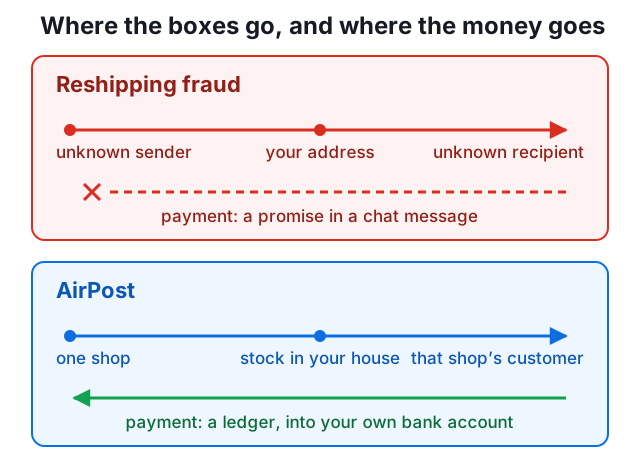
What is a reshipping scam exactly?
A reshipping scam — also called a parcel mule or package mule scheme — uses your home address to launder stolen goods. It is not a bad job. It is a crime with you standing in the middle of it.
It runs in the same five steps almost every time, and there is a reason behind each one.
- They approach you. Someone contacts you out of nowhere with an easy work-from-home offer: receive parcels, repack them, send them on. Often through a job board, a messaging app, or a dating app.
- Goods start arriving. Electronics, phones, designer items — things that are easy to resell, delivered to your address.
- Those goods are stolen. Bought with stolen card details or hijacked accounts. Your address is the drop point that keeps the buyer invisible.
- You forward them. Relabel and send on, usually abroad, sometimes with prepaid labels sent to you by email.
- The payment never comes. Or it arrives once and then stops. Meanwhile the chargebacks, the police reports and the carrier investigations all point at your address.
Some versions add a second layer. You are asked to pay for postage yourself and get reimbursed later, or to accept a payment and forward part of it.
That is money muling on top of parcel muling, and it turns your bank account into evidence. It is also the moment the damage moves from "no wages" to "a frozen account".
The person packing the boxes is the only one in the chain with a real name and a real address. That is not a side effect of the scam — it is the point of it.
How do you recognise a reshipping scheme?
Every reshipping scheme has to do the same five things to work. That is what makes them recognisable, whatever the cover story is.
They do not all weigh the same. Below is what each signal means, what a legitimate platform does instead, and how hard it lands.
| Signal | What it means | What a legitimate platform does | Weight |
|---|---|---|---|
| They approached you | You were picked for being reachable, not for being suitable | You sign up yourself and choose which work you take on | Heavy |
| The goods come from strangers | Nobody in the chain has a name, except you | Stock arrives up front from one shop you have an agreement with | Decisive |
| No contract and no company | There is nothing to fall back on when it goes wrong | Terms, a registered company, a record per order | Heavy |
| You have to advance money | The scheme earns from you rather than from the work | Never — the shipping label is paid for by the shop | Decisive |
| Payment happens outside any system | You have no claim, only a chat thread | A ledger, paid out to a bank account in your own name | Decisive |
1. They approached you
Unsolicited contact is the single strongest signal. A message on WhatsApp or Telegram, a reply to a CV you posted, a "hiring manager" who found your profile.
Legitimate work is something you go and find, not something that finds you with an offer attached. Whoever approached you picked you because you were reachable — not because you are suitable.
2. The goods come from strangers
You receive parcels from senders you have never dealt with, and you forward them to recipients you know nothing about. Nobody in the chain has a verified identity except you.
This is the point where it stops being about trust and starts being about liability. Your address is on every transport document; the rest of the chain is on none of them.
3. There is no contract and no company
No written agreement, no registered company you can look up, no invoice, no terms. Ask for a company registration number and the conversation changes tone or ends.
A company name you can look up is not proof either. Check that the address and the stated activity in the register match what you are being told.
4. You have to advance your own money
Postage, packaging, a "processing fee", a deposit for equipment. Any arrangement where money leaves your account before any arrives is not a job.
This signal is decisive because it gives away the intent: in real work the client earns from the service, not from the person providing it.
5. Payment happens outside any system
Cash, gift cards, crypto, or a bank transfer from a private person with an unrelated name. There is no payout you can check, no statement, no record.
And so no way to be paid if they simply stop replying. If you cannot see the amount owed to you anywhere other than in a chat message, you do not have a claim — you have a hope.
One is caution, two is walking away
At two or more of these, end the conversation without further explanation. You do not owe politeness to someone who wants to use your address.
What do you do if the parcels are already in your house?
This is where most warning pages stop, and it is exactly the question of someone who finds this article too late. The order below is the order that matters.
Forward nothing more
Not the parcel that is already packed, and not "just this one". Every shipment you still send is an act of yours, with your name on the label.
Stop replying
No explanation, no final message, no request for your money. Block the number and the account. Someone using your address is not owed a closing conversation.
Keep everything
Boxes, labels, proofs of postage, emails, chat threads and bank statements. Take screenshots before an account is deleted; that often happens within a day.
Report it to the police
A fraud report, with the material you kept. You are the victim here, and reporting it yourself is exactly what separates you from an address that only turns up during an investigation.
Report it to a national fraud desk
In the Netherlands that is the Fraudehelpdesk; elsewhere in the EU your national equivalent. They collect reports and can tell you what makes sense in your case, and it helps the next person who sees the same advert.
Call your bank if money passed through
If you advanced postage, received an amount or forwarded part of one, tell your bank. Forwarded money turns your account into evidence, and you want to be ahead of that.
Nothing sent yet?
Then probably nothing irreversible has happened. Refuse the next delivery, leave the parcels sealed, and work through the steps above from step two.
How does this model differ from reshipping fraud?
| Reshipping fraud | AirPost | |
|---|---|---|
| How it starts | They approach you, unsolicited | You sign up yourself |
| Where the goods come from | Unknown senders, different ones each time | One shop you have an agreement with |
| What you do with a parcel | Forward it to an unknown recipient | Pack an order from stock already in your house |
| Identity | Only yours is known | Both sides verified with passport and selfie |
| Payment | Cash, crypto, private transfer | A ledger, paid out to your own bank account |
| Advancing money | Postage, deposits, "processing fees" | Never — the shop buys the shipping label |
| Paperwork | No contract, no company | Terms, a registered company, a record per order |
| Stopping | They disappear, you are left with it | You finish your open orders and the stock goes back |
Where AirPost is materially different
- The stock arrives up front, from one shop. You agree with a specific online shop, they send you a batch of their own products, and it sits with you. There is no stream of parcels from strangers.
- You never forward anything from a third party. You pack an order from stock that is already in your house and drop it at a service point. Nothing passes through you from someone you have not agreed to work with.
- Both sides are identity-checked. A sender can only receive stock and pick up orders after an identity check with passport and selfie, and a payout account verified in their own name. Shops go through the same gate. That is a limit in our database, not a badge on a profile.
- Payment runs through a ledger, not a private transfer. Your fee is booked when the order is handed over, it is visible in your account, and it is paid out to the bank account in your own name.
- You never advance money. No deposit, no subscription, no postage to pay. The shipping label is bought by the shop, not by you.
The short version: a reshipping scam needs an anonymous chain and an untraceable payment. This model has neither, because it cannot work without both parties being known to each other and to us.
What it pays is a separate question, and it is answered with real figures in How much can you earn packing parcels from home?. Where the work exists at all depends on the live rate card, which that article also shows.
What we do not promise
An article that only lists reassurances is itself a warning sign, so here is the other side. What the model does ask of you — a shelf, a printer, an ID check, a bank account in your name — is in what you need to pack parcels from home.
- Verification is not insurance. It keeps anonymous fraud out. It does not guarantee that every shop is pleasant to work with, or that a parcel never goes missing.
- This is not employment. There are no fixed hours, no guaranteed volume and no notice period.
- The income is a supplement, not a salary. Anyone telling you otherwise about work you do in the margins of your day is selling something.
- You are responsible for your own tax. We give you a yearly overview; we do not give tax advice.
- What we do run: an identity check on both sides, a record of every order, and help filing a claim when a carrier loses a parcel.
What do you check before you accept a box from anyone?
- Look up the company. A registration number in a public business register, an address, a VAT number. If none of that exists, stop.
- Read what you are agreeing to before you agree to it, and make sure it exists in writing.
- Check how you get paid, and when. If you cannot see the amount owed to you somewhere other than in a chat message, you have no claim.
- Confirm that nothing leaves your account first. No postage, no deposit, no fee.
- Ask where the goods come from. If the answer is a person rather than a shop with a website you can visit, that is your answer.
- Search the company name plus the word "scam" before you say yes. It costs a minute.
Frequently asked questions
Is packing parcels from home always a scam?
No, but most unsolicited offers are. The difference is in the chain: if parcels arrive from strangers and you forward them on, it is reshipping fraud. If you pack orders from stock belonging to one shop you agreed to work with, it is ordinary work.
What is the biggest difference from a parcel mule scheme?
That you forward nothing. The stock arrives up front from one shop you have an agreement with and stays with you; no parcel ever passes from an unknown sender to an unknown recipient.
I have already forwarded parcels. What now?
Forward nothing more, stop replying, and keep every box, label and message. Then report it to the police and to a national fraud desk. If money passed through your account, call your bank as well.
Do I have to show my passport? Is that not suspicious in itself?
The reverse question is the one that matters: anyone who does not run an identity check cannot know who is receiving the stock. We check both sides, and that is exactly why an anonymous scheme cannot run here.
Can I lose money?
You advance nothing: no deposit, no subscription, no postage. The shipping label is bought and paid for by the shop, so money never leaves your account before any arrives.
When do I get paid?
Your fee is booked as soon as the order is handed over at the service point, and becomes payable after 3 days. Everything is visible in your account and paid to the bank account in your own name. The whole chain is in [how payouts work when you pack parcels from home](/en/blog/how-payouts-work-for-senders).
What happens if a parcel goes missing?
Carriers are responsible for delivery. We hold the shipment details and help you file a claim; we are not an insurer.
Sources
The honest test is not whether the work sounds too good. It is whether you can name the company, read the agreement, and see the money before you touch a single parcel.
Want to see how it works here?
Create an account