In short
- "No minimum" is real, but it is more often a positioning of small providers than of large ones.
- Where a provider has no order minimum, check for a minimum monthly invoice instead — that is the same mechanism with a different name.
- Four of the eight below state no minimum at all; one publishes a €500 monthly minimum invoice; two publish nothing and quote per case.
- Storage is the item that separates them: per pallet, per shelf location, per cubic metre per day, or none at all.
- Country matters as much as price. Stock in Poland is cheaper to hold and further from a Dutch customer.
- The list is alphabetical and we are last, because a comparison in which the author ranks first is an advert.
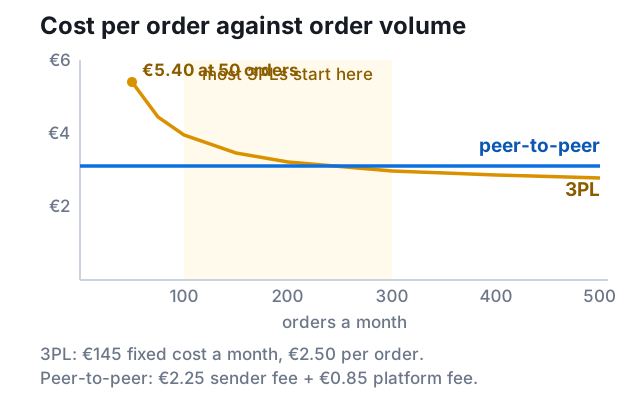
Most fulfilment providers in Europe start being interested somewhere between 100 and 500 orders a month. Below that their fixed costs — space, staff, warehouse software, inbound handling — are spread over too few orders to make an offer either side wants.
Some providers take small sellers anyway, and a handful say so on their own website. This is a list of eight of them, with what each one publishes about its minimum, how it charges for storage, and where it holds stock.
We run the last one. It is last for that reason, and the rest are in alphabetical order.
Where these figures come from
Every line is what the provider publishes on its own pages, checked in September 2026. Where a provider publishes no rate, this article says so rather than guessing. Sources are at the bottom, and you should always request a quote on your own volume.
The eight at a glance
| Provider | Minimum they publish | Storage model | Where |
|---|---|---|---|
| Boxxl | None stated; handling from €3.75 | Not published | Netherlands |
| FLEX Fulfillment | None stated; no onboarding cost | Not published | DE, FR, PL, UK |
| Fulfilment.nl | €500 minimum invoice per month | Modular, per item | Netherlands |
| GS-Fulfilment | None — "no minimum per day or per month" | Per week, on space actually used | Netherlands |
| isklad | None stated | Per cubic metre per day | Slovakia, ships EU-wide |
| Monta | None published; quote per case | Per cubic metre used, monthly | NL, BE, DE and more |
| Omnipack | Advises roughly 500–1,000 parcels a month | Billed on the volume of that month | Poland, ships EU-wide |
| AirPost | None — billed per shipment | None — stock sits with a person, not a warehouse | Countries with a domestic service |
The eight, in order
1. Boxxl — the published rate card
A Dutch provider that does something unusual for this market: it puts numbers on the page. Handling from €3.75, €0.55 per extra item in an order, €2.45 per return, and no set-up or connection fees.
No minimum order volume is stated. Packaging and filling material are included in the price, which is a real cost saved rather than a rounding item.
Worth a look if you want to compare a quote against a published rate before you start negotiating.
2. FLEX Fulfillment — several countries, one contract
A European provider with warehouses in Germany, France, Poland and the UK. No onboarding cost and a flexible contract, with packing materials and shipping labels folded into the per-order price.
The multi-country footprint is the point: it lets you hold stock closer to the market you actually sell into without arranging four separate relationships.
What that does not remove is the VAT registration in each country where stock physically sits — see VAT when you store stock in another EU country.
3. Fulfilment.nl — no minimum orders, but a minimum invoice
A Dutch provider with tiered service levels, starting at "Small" for up to 500 orders a month. No set-up costs, no account management fee and no software fee.
It does publish a minimum invoice value of €500 a month. That is the honest version of a minimum: at 60 orders a month it works out at €8.33 an order, which is a number you have to compute yourself.
This is the pattern to watch for everywhere. "No minimum orders" and "minimum monthly spend" are the same constraint wearing different clothes.
4. GS-Fulfilment — the clearest no-minimum claim
A provider in Eindhoven that states it plainly: no minimum volume, no minimum per day and no minimum per month, and you can start with a handful of orders a day.
Storage is charged per week on the space actually used, with no fixed monthly cost. Rates are quoted per case rather than published, and depend on product size, weight, items per order and destination.
The charging model matters more than the headline here: paying weekly for the space you use is what makes a small, uneven volume survivable.
5. isklad — micro-fulfilment out of Slovakia
A Central European provider with no order minimum and warehousing priced per cubic metre per day, so the cost scales down in a slow month instead of holding you at a fixed monthly figure.
Central European fulfilment is meaningfully cheaper to run than Western European, which is the whole argument for holding stock there.
The counter-argument is transit time. Slovakia to a German or Dutch customer is an intra-EU parcel, not a domestic one, and that shows up in delivery days.
6. Monta — the large end, without a published floor
One of the larger operators in the Netherlands, with warehouses across several countries. It publishes no standard rates at all and quotes per case, with no fixed contract and billing on what you use.
No minimum order volume is published either, which is not the same as there being none. At this end of the market the constraint usually turns up in the quote rather than on the website.
The right way to use a provider like this is to ask for a quote on your real volume and then divide the monthly total by your order count.
7. Omnipack — honest about the volume it wants
A Polish provider shipping across the EU, which does something the others do not: it says what scale makes sense. It advises roughly 500 to 1,000 parcels a month before fulfilment is worth it for you.
That is a recommendation rather than a hard gate, and it is more useful than a "no minimum" claim with a quote you cannot see.
Polish operations run materially cheaper than Western European ones, so the trade is the same as with isklad: lower cost per order, more transit days to a Dutch or German customer.
8. AirPost — no warehouse at all
Ours, and last on the list for that reason. It is not a warehouse: a verified person near your customers holds a batch of your stock at home, packs the orders and drops them at a service point.
You pay per shipment — €2.25 recommended sender fee for a small parcel plus €0.85 platform fee, so about €3.10 in fulfilment per order, plus the carrier rate you were paying anyway.
There is no storage fee because there is no warehouse to rent, and no minimum because there are no fixed costs to spread. That is the same reason it is the wrong answer above a few hundred orders a month.
- Small and light products, tens to a few hundred items per batch.
- Uneven or seasonal volume, because you pay per shipment and not per month.
- Selling into a country where you do not want to rent anything.
- Large, heavy, chilled or licensed goods — that needs a warehouse with the right permits.
- Hundreds of SKUs, or thousands of items of stock.
- Same-day promises or fixed collection windows.
How do you read a "no minimum" claim?
A minimum rarely appears as "minimum orders" in a quote. It appears in one of four other places, and all four have the same effect on your cost per order.
- A minimum monthly invoice. The clearest version. Divide it by your real order count to see your true cost per order.
- A tier or staffel. "Small, up to 500 orders" is fine; "Small, from 200 orders" is a minimum with a friendlier name.
- A set-up fee. Several hundred euros amortised over your first year is a fixed monthly cost, whatever the invoice calls it.
- Storage priced per pallet. A pallet you half fill is a pallet you fully pay for. Per cubic metre or per shelf location scales down; per pallet does not.
The one number that makes all of them comparable is your total monthly fulfilment cost divided by your order count. Everything above that is a rate; this is a price.
What should you ask before you sign?
Send one real month of data
Order count, average items per order, return rate, and how much shelf or pallet space your stock needs. Without those four, any quote you get back is a guess dressed as a number.
Ask for all five cost items, plus returns
Set-up, storage, pick and pack, inbound, shipping — and returns separately. A quote with only a pick-and-pack rate in it is not a quote.
Ask how storage is measured
On the peak of the month or on the average? That difference is tens of percent in the fourth quarter, when you are holding your Christmas stock.
Ask about the minimum invoice explicitly
Not "is there a minimum" — ask what the smallest amount you can be invoiced in a month is. The answers differ.
Ask what happens in a slow month
A provider charging per cubic metre per day answers this differently from one charging per pallet per month, and the difference only shows up in January.
Convert everything to cost per order
Monthly total divided by order count, for each quote and for your current situation including your own hours. That is the only comparable number.
Which one fits you?
| Your situation | What usually fits |
|---|---|
| Under 50 orders a month, small products | Peer-to-peer, or a provider charging storage per week or per m³ |
| 50–200 orders a month, one country | A small 3PL with no minimum and published rates |
| 200–1,000 orders a month | A mid-sized 3PL; ask for a quote and compare on cost per order |
| Above 1,000 orders a month | A larger operator, where negotiated rates beat any published one |
| Cost matters more than transit days | Central or Eastern Europe, shipping intra-EU |
| Transit days matter more than cost | Stock in the country you sell into most |
If the reason you are looking is the €3 per product type on every import since July 2026, the relevant sum is not which provider but whether local stock beats importing at all. That is in IOSS versus holding stock in the EU.
Frequently asked questions
Which EU fulfilment providers have no minimum order volume?
GS-Fulfilment states it explicitly — no minimum per day or per month. Boxxl, FLEX Fulfillment and isklad state no minimum either. Fulfilment.nl does publish a €500 minimum invoice per month, and Monta publishes nothing and quotes per case.
Is "no minimum orders" the same as "no minimum cost"?
No, and that is the trap. Check for a minimum monthly invoice, a set-up fee spread over your first year, and storage priced per pallet. All three are fixed costs regardless of what the order minimum says.
What does fulfilment cost per order in Europe?
Published rates for pick, pack and handling generally sit between about €1.50 and €6.50 per order depending on size, weight and country, with storage and returns on top. Central and Eastern European providers run materially cheaper than Western European ones.
Do I need a VAT number in the country where my stock sits?
Generally yes, and there is no threshold for it. Holding stock in a country makes your sales from that stock domestic supplies there. OSS does not remove that obligation.
Is it cheaper to hold stock in Poland than in the Netherlands?
Usually, per order. What you give back is transit time to Western European customers, because a parcel from Poland to a Dutch customer is intra-EU rather than domestic.
Can I start with one product line instead of my whole catalogue?
Yes, and with most of these providers that is the sensible first step. Put your best sellers somewhere for a month and compare your real cost per order against what you do today.
Sources
- Boxxl — published fulfilment rates
- FLEX Fulfillment — European warehouses and onboarding
- Fulfilment.nl — rates, tiers and the minimum monthly invoice
- GS-Fulfilment — fulfilment for small shops, on minimum volume
- isklad — how to choose a fulfilment provider in Central Europe
- Monta — fulfilment pricing and quotations
- Omnipack — fulfilment from Poland for the European market
A minimum is not a policy. It is a fixed cost that has to land somewhere, and the only question is whether it lands on you.
See which countries have a domestic service today
Where we are active