In short
- Dropshipping and peer-to-peer fulfilment look alike from your desk: in both, someone else packs and ships. They differ on who owns the stock, and everything else follows from that.
- Dropshipping wins on two rows: you need no capital for stock, and you carry no risk of being left with it. Those are real advantages and they are the reason the model exists.
- Peer-to-peer wins on transit time, control over packaging and quality, customs position and margin per order — because your goods are already in the customer’s country when the order arrives.
- Per order you pay a sender’s fee plus a €0.85 platform fee — about €3.10 for a small parcel — with a domestic carrier rate on top. Dropshipping charges you a marked-up product price that hides the fulfilment cost inside it.
- The switch is not all-or-nothing. The usual path is to dropship to find out what sells, then buy one batch of the winner and hold it near your customers.
- Neither model suits bulky, chilled or regulated goods, or a catalogue of hundreds of SKUs. Those need a warehouse, whoever runs it.
Ask a Shopify beginner what fulfilment model they run and the answer is usually dropshipping — not because they compared it against anything, but because it was the only option that did not require money up front.
Ask the same person six months later what they would change and the answer is nearly always the same three things: shipping times, the packaging they cannot control, and the support tickets that follow from both.
Peer-to-peer fulfilment is the model that fixes those three, at the cost of the one thing dropshipping made unnecessary: buying stock. This article puts the two next to each other on the rows that matter, including the ones where dropshipping is the better answer.
What is the actual difference?
In dropshipping you list a product you do not own. When it sells, you pass the order to a supplier — usually outside the EU — who ships it to your customer. You paid the supplier a per-unit price that includes the goods, the packing and the shipping. You never see the parcel.
In peer-to-peer fulfilment you buy a batch of the product, and send it to a verified individual in the country where your customers are. That person holds your stock at home, packs each order when it comes in, buys the label and drops the parcel at a parcel point. You never see the parcel either.
The parcel leaves someone else’s hands in both cases. But in one case it leaves a supplier’s warehouse in Shenzhen, and in the other it leaves a shelf twenty kilometres from your customer. The full definition of the second model is in what is peer-to-peer fulfilment.
Side by side, on the rows that matter
| Dropshipping | Peer-to-peer fulfilment | |
|---|---|---|
| Who owns the stock | The supplier | You |
| Capital up front | None | One batch — tens to a few hundred units |
| Risk of unsold stock | None | Yours, limited to the batch |
| Where the parcel starts | Usually outside the EU | The customer’s own country |
| Transit to the customer | Typically weeks | Domestic parcel — days, not weeks |
| Customs | Every parcel is an import; since July 2026 with duty per product type | One bulk import, then domestic parcels |
| Packaging and insert | The supplier’s | Yours |
| Quality check before dispatch | None you can see | A person opened the box and packed it |
| Cost per order | Hidden in the marked-up unit price | Sender’s fee + €0.85, about €3.10 small parcel, plus a domestic label |
| Returns | Rarely worth the return shipping; usually refunded and written off | Back to the sender, back into stock |
| Catalogue width | Unlimited — you can list anything | Narrow — a few SKUs that sell |
| Minimum volume | None | None |
Where dropshipping is genuinely better
It would be easy to write this section as a formality. It is not one. Dropshipping solves a real problem that peer-to-peer does not touch.
- You do not know what will sell yet. Buying a batch of a product nobody wants is the most expensive mistake a small shop makes. Dropshipping lets you list twenty products and find out which three move, for the price of some ad spend.
- You have no capital. A batch of fifty units is real money. If that money is not there, the choice is dropshipping or nothing, and dropshipping is better than nothing.
- You sell a wide, shallow catalogue. Hundreds of products with a handful of orders each cannot be held as batches in someone’s home. That is a warehouse problem, and dropshipping is the warehouse you do not have to rent.
The honest summary: dropshipping is a research tool and a bootstrap. It is very good at both, and it becomes a liability the moment you know what sells and have the cash to buy it.
Where peer-to-peer is better, and why
Transit time
A parcel that starts in your customer’s country is a domestic parcel. It travels for days, not weeks, with the tracking of a carrier your customer recognises. That is not a service you buy; it is a consequence of where the stock sits.
Customs, since July 2026
Every dropshipped parcel from outside the EU is an import, and since July 2026 every import carries customs duty per product type — on top of the VAT that was already due, and on top of the handling fee the carrier charges to collect it. A bulk shipment into local stock is one import event; the parcels after it are not imports at all. The detail is in how to sell to the EU without customs charges.
Control
The box, the insert, the invoice, whether the item matches your photos: in dropshipping you find out about problems at the same moment your customer does. In peer-to-peer a person you chose opened the batch, saw the products and packs each order in the packaging you sent.
Margin
A dropshipping supplier charges a unit price that bundles the goods, the packing and the international shipping. You cannot see the fulfilment cost, but you are paying it, and it is not small. Peer-to-peer shows it: a sender’s fee plus €0.85, about €3.10 for a small parcel, with a domestic label on top — and you bought the goods at a bulk price instead of a per-unit one.
Returns
A return in dropshipping is usually a refund and a write-off, because sending one unit back across a border costs more than the unit. A return in peer-to-peer goes back to the sender and onto the shelf.
What peer-to-peer does not solve
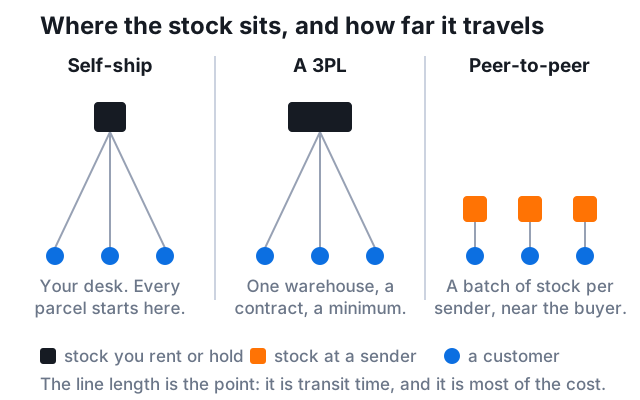
Stock in someone’s home is at risk in someone’s home. Verification and stock records lower the odds; they are not insurance. And there is no economy of scale: above a few hundred orders a month a warehouse beats this on cost, which is the comparison in peer-to-peer fulfilment vs a 3PL.
That last point is worth its own article, and it has one: peer-to-peer fulfilment vs a 3PL, with the crossing point worked out.
How to move from one to the other
Almost nobody should switch everything at once, and almost nobody needs to. The two models coexist well in one store, because they are good at different stages of a product’s life.
Keep dropshipping the long tail
Products with a few orders a month stay where they are. There is no batch worth buying.
Pick the one product that clearly sells
Your best seller by orders, not by revenue. One product means one number to compare and a mistake that costs one batch.
Buy one batch, roughly a month of orders
Import it once, in bulk, on your own name. That is one customs event instead of one per parcel.
Send it to a sender in your biggest market
The country where you have the most orders after your own. Connect your Shopify store so paid orders for that product route to them automatically.
Run a month and compare four numbers
Cost per order, transit time, support tickets, return rate. If you only compare the first, you will miss what actually changed.
Move the next product, not the whole store
If it worked, the second best seller. If it did not, you have lost one batch and learned your real numbers — which you needed anyway.
The stock-free version of this — what fulfilment without a warehouse looks like for a shop that has never held inventory — is on /en/fulfilment-without-a-warehouse.
Frequently asked questions
Is peer-to-peer fulfilment a form of dropshipping?
No. In dropshipping the supplier owns the stock and ships from their location, usually outside the EU. In peer-to-peer fulfilment you own the stock and it sits with a verified individual in your customer’s country. Only the fact that you do not pack the parcel is shared.
Which is cheaper per order?
Usually peer-to-peer, once you count the fulfilment cost hidden inside a dropshipping unit price and the customs duty and handling on each imported parcel. Peer-to-peer costs a sender’s fee plus €0.85 — about €3.10 for a small parcel — with a domestic label on top.
When should I stay with dropshipping?
When you do not yet know what sells, when you have no capital for a batch, or when your catalogue is wide and shallow. Dropshipping is a good research tool and a good bootstrap.
How much stock do I need to start?
One batch of one product, sized to about a month of orders in one country. Tens to a few hundred units. Not your catalogue.
What about customs?
A dropshipped parcel from outside the EU is an import, with VAT, customs duty per product type since July 2026 and a carrier handling fee. A bulk shipment into local stock is one import; the parcels after it are domestic.
Can I run both models in one Shopify store?
Yes, and most shops should. Dropship the long tail; hold batches of the few products that clearly sell near the customers who buy them.
Sources
Dropshipping tells you what sells. Peer-to-peer is what you do with that answer.
Route paid Shopify orders to a sender near your customer
Airpost Order Link for Shopify