In short
- Holding stock in a country makes your sales from that stock domestic supplies there, so you need a local VAT number.
- There is no threshold. The €10,000 distance-selling threshold covers cross-border sales, not sales from local stock.
- OSS is a reporting simplification, not an exemption. Sellers using OSS still hold local numbers wherever their inventory sits.
- IOSS is a different scheme for a different problem: goods imported into the EU in consignments of €150 or less.
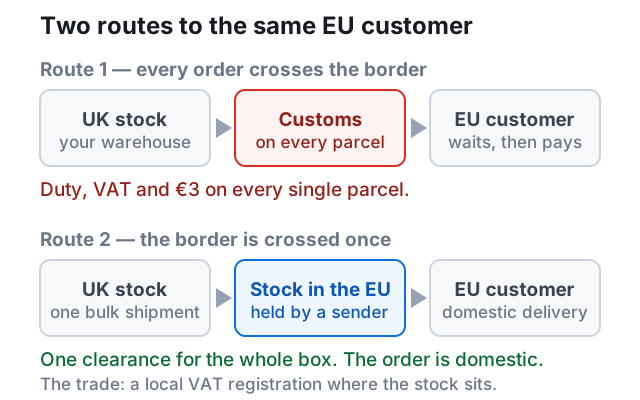
- Since 1 July 2026 the duty relief under €150 is gone. Importing costs €3 per product type in the consignment, charged to you rather than to your customer.
- Businesses established outside the EU generally need a fiscal representative in the Netherlands, plus a security deposit.
This is the objection that comes up first, and the one most fulfilment providers quietly skip: if you put stock in another EU country, do you need a VAT number there?
For the Netherlands the answer is yes, without a threshold, from the moment you hold stock — and no, the One Stop Shop does not take that away.
We would rather say that plainly than have you find out after your first box has shipped. What follows is a summary of the rules as they stand in September 2026, what it means for you depending on where your business is established, and an honest answer to the question underneath the question: is the registration worth it?
General information, not tax advice
VAT rules change and they depend on your specific situation. Check with the Belastingdienst or a tax adviser before you act on any of it.
Why does storing stock create a registration?
EU VAT follows the goods, not the company. The moment your goods are physically in a country and are sold from there, that sale is a domestic supply in that country — and a domestic supply needs a local VAT number.
Two consequences that surprise people:
- There is no threshold. The €10,000 EU-wide distance-selling threshold applies to cross-border sales, not to sales made from stock already inside the country. Registration is due from the first transaction, and in practice from the moment you hold the stock.
- Moving your own goods into the country is itself a taxable event. Transferring your own stock from one EU country to another is treated as an intra-Community acquisition — you are, for VAT purposes, both the seller and the buyer of that movement, and you report it.
This is the same rule that has always applied to Amazon FBA: sellers whose inventory sits in German and Polish warehouses need German and Polish VAT numbers, regardless of turnover.
Why does OSS not solve it?
The Union One Stop Shop is a reporting simplification. It lets you declare cross-border B2C sales to consumers in other EU countries through a single return in one member state, instead of filing in each of them.
It is genuinely useful and it is why most cross-border sellers use it. What OSS does not do is remove a registration obligation that comes from something other than a cross-border sale.
Holding stock in a country is exactly such a something. In practice sellers using OSS still hold local VAT numbers wherever their inventory sits, and they use OSS alongside those numbers rather than instead of them.
There is a second, less obvious effect: once you hold a VAT number in another EU country because of storage, the €10,000 threshold that let small sellers charge home-country VAT on cross-border sales is no longer available to you.
What is the difference between OSS and IOSS?
| Union OSS | IOSS | |
|---|---|---|
| What it covers | B2C sales to consumers in other EU countries | Goods imported into the EU from outside it |
| Value limit | None | €150 intrinsic value per consignment |
| Where the goods start | Inside the EU | Outside the EU |
| What it replaces | Filing a return in every country you sell to | VAT collected at the border on arrival |
| Does it replace local registration? | No — not where you hold stock | No — it says nothing about goods already in the EU |
| Intermediary needed? | No | Usually yes for non-EU sellers |
Three things worth knowing if you are a UK or non-EU seller:
- IOSS covers imports. It does nothing for goods that are already inside the EU — that is the local registration above.
- Non-EU sellers generally need an EU-established intermediary who is jointly liable for the VAT. UK businesses have their own route via HMRC, and since April 2026 an intermediary can also be registered through HMRC; which one fits depends on your volume and how much administration you want to run.
- IOSS is about VAT, not about duty. That distinction used to be academic below €150. Since 1 July 2026 it is not, and that is the next section.
What changed on 1 July 2026?
The customs duty relief for consignments with an intrinsic value of €150 or less has been abolished. In its place there is a flat charge of €3, as an interim measure until the EU customs data hub arrives, expected in 2028.
Three details decide what it costs you, and all three are easy to miss.
| Detail | What it means for a parcel |
|---|---|
| It is per product type, not per parcel | The €3 is charged per tariff heading in the consignment. Three different product types in one box is €9, not €3. |
| It is charged to you, not to your customer | The seller, importer or their representative pays it. It does not arrive as a surprise at the door — it arrives in your margin. |
| Intrinsic value is the goods alone | Shipping and insurance do not count towards the €150. A €140 order with €15 postage is still a low-value consignment. |
For a seller with a €25 average order and two product types per parcel, that is €6 on every order — before shipping, before VAT, before returns. On a 40% gross margin it is most of what was left.
That is why holding stock inside the EU stopped being only a delivery-time question in July 2026. The four routes out of it, with the cases where each one loses, are set out in Selling to the EU without customs charges. The charge itself is taken apart in The EU's €3 customs charge.
What does this mean for you, per situation?
| Where you are established | Local VAT number needed? | Fiscal representative? | Typical lead time |
|---|---|---|---|
| In the country where the stock sits | You already have one | No | None — nothing changes |
| Elsewhere in the EU | Yes, in addition to your home registration | Not usually | Days to a few weeks |
| United Kingdom or outside Europe | Yes | Generally yes, plus a deposit or bank guarantee | Several weeks |
You are already established in the country
A Dutch shop putting stock with someone in the Netherlands, a German shop with stock in Germany. Nothing changes: you already have a local VAT number and your sales are already domestic supplies.
This is the simplest case by a wide margin, and it is why sellers who live in the country they sell to have the least to think about here.
You are established elsewhere in the EU
You register for VAT in the country where the stock sits, in addition to your home registration. You do not usually need a fiscal representative — that requirement applies to businesses established outside the EU.
You keep using OSS for your cross-border sales, and file locally for sales made from the local stock. Which country to choose, and what else differs between them, is in Where to hold stock in Europe.
You are established in the UK or outside Europe
Same registration obligation, plus one extra step: businesses established outside the EU generally have to appoint a fiscal representative in the Netherlands — a Dutch party that handles the registration and returns and is answerable to the tax authority for you.
Expect them to ask for a security deposit or bank guarantee, and expect the registration itself to take a few weeks rather than a few days. That fixed cost is exactly what the break-even calculation in IOSS versus holding stock in the EU is about.
What does AirPost do and not do?
We match online shops with people who store a small batch of stock at home, pack the orders and drop them at a service point. That is the whole product, and it is worth being precise about the edges.
- We do not register you for VAT anywhere.
- We are not a fiscal representative and we cannot act as one.
- We do not give tax advice, and nothing on this page is advice.
- We do not take a position on whether your specific arrangement triggers a registration. That is between you and the tax authority.
- We do not clear your bulk shipment through customs. That is between you, your carrier and your broker.
- We do give you the record: every order, every label and every fee is in your account, so whoever files your returns has something to work from.
So — is the registration worth it?
That is the real question, and it is a commercial one rather than a tax one. A VAT registration is a fixed annual cost in administration.
Local stock buys you a domestic delivery time, no customs step for your customer, and since July 2026 no €3 per product type on every order. So the question is whether those three are worth more than the first.
The honest answer is that it depends on two numbers you already have: how many parcels you send to that country, and what a cross-border parcel currently costs you in shipping, in duty and in delivery days.
The table below comes straight from the live rate card, so you can put your own numbers next to it rather than take ours.
Domestic rate and transit time, per country
| Country | Transit | Letterbox parcel | Small parcel | Medium parcel |
|---|---|---|---|---|
| Austria | 1 working day | — | €7.25 | €7.25 |
| Belgium | 1 working day | — | €5.38 | €6.08 |
| France | 1 working day | — | €8.62 | €11.42 |
| Germany | 2 working days | — | €6.00 | €7.05 |
| Italy | 2 working days | — | €4.46 | €4.46 |
| Netherlands | 1 working day | €5.50 | €6.85 | €6.85 |
| Spain | 1 working day | — | €8.00 | €8.65 |
A rough rule: below a handful of parcels a week to a single country, the administration will usually outweigh the gain. At a steady weekly volume the calculation flips.
It flips faster than it used to, because the €3 per product type now sits on the cross-border side of the sum. And it flips faster still if the delivery time is costing you conversions rather than just money.
Run the numbers before the paperwork
Take one real month: parcels to that country, current shipping cost per parcel, duty per parcel, current transit time. Compare it with the domestic rate above and with what a registration costs you per year. If the gap is small, wait.
The point of this article is not to talk you into a VAT number. It is to make sure that if you get one, you knew about it before the first box shipped.
Frequently asked questions
Do I need a Dutch VAT number if I store stock in the Netherlands?
In general yes, from the moment you hold the stock, because sales made from it are domestic supplies in the Netherlands. There is no turnover threshold for this. Confirm your own situation with the Belastingdienst or an adviser.
Does OSS mean I can skip the local registration?
No. OSS is a way of reporting cross-border sales through a single return. It does not remove an obligation that arises from holding stock in a country.
What is the difference between OSS and IOSS?
OSS covers B2C sales to consumers in other EU countries where the goods are already in the EU. IOSS covers goods imported into the EU in consignments with an intrinsic value of €150 or less.
Does the €3 customs charge apply to stock I already hold in the EU?
No. It applies to goods imported into the EU in a low-value consignment. Once the goods are inside the EU, an order shipped from that stock is a domestic or intra-EU supply and no import duty arises on it.
Do I need a fiscal representative?
Businesses established outside the EU generally do for a Dutch registration, and should expect a security deposit or bank guarantee. Businesses established elsewhere in the EU usually do not.
Is moving my own stock to another EU country a taxable transaction?
Yes. Transferring your own goods between EU countries is treated as an intra-Community supply and acquisition, and you report both sides of it.
How long does a Dutch VAT registration take?
Days to a few weeks for an EU-established business with a complete application; several weeks for a non-EU business that also has to appoint a fiscal representative.
Sources
- Belastingdienst — VAT for foreign entrepreneurs, on registration and fiscal representation
- European Commission — One Stop Shop, the Union and Import schemes explained
- European Commission — removal of the €150 customs duty exemption threshold in 2026
- European Commission — EU customs reform and the customs data hub
Rules change. This article was last checked in September 2026; if you are reading it much later, verify with the Belastingdienst before you rely on it.
See what a domestic parcel costs in each country we cover
Where we are active