In short
- A 3PL has fixed costs and peer-to-peer fulfilment does not, so the answer is a crossing point rather than a winner.
- Cost per order is the only comparable number. A rate card is not a price until you divide the monthly total by your order count.
- A 3PL quote has five items, not one: set-up, storage, pick and pack, a minimum invoice, and returns. Three of the five are fixed.
- Peer-to-peer costs the same per order at every volume — around €3.10 for a small parcel, plus the carrier rate you were paying anyway.
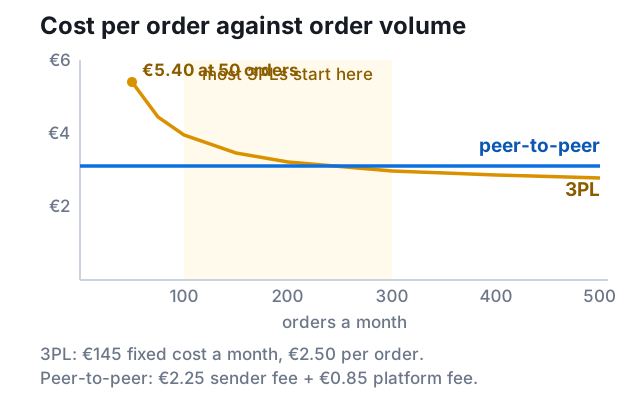
- On the example quote below the two cross at about 242 orders a month. Your quote will cross somewhere else, which is what the calculator is for.
- Under roughly 100 orders a month the 3PL is usually not close. Above a few hundred it wins, and it should.
- The number that decides it is your storage and set-up cost, not the pick-and-pack rate everyone compares.
Every comparison of fulfilment options starts with the wrong number. Someone quotes €2.50 a pick, someone else quotes €3.10, and the conversation is about sixty cents.
That sixty cents is almost never what decides it. At 50 orders a month a €120 storage bill is €2.40 an order on its own — four times the difference everyone is arguing about.
This article does the comparison the other way round: fixed costs first, then the crossing point, then a calculator so you can put your own quote next to it instead of ours.
It assumes you already know what the second model is. If not, start at what is peer-to-peer fulfilment — including the section on the four cases where it is the wrong answer.
Why is cost per order the only fair measure?
A fulfilment provider sells you a rate card. A rate card is a list of prices for things, and it becomes a price only once you know how many of each thing you will buy in a month.
Take your total monthly fulfilment cost — everything on the invoice, including the items that would be there in a month with zero orders — and divide it by the number of orders you actually shipped. That number is comparable between any two providers, and between a provider and doing it yourself.
It is also the number that moves fastest at low volume, because that is what fixed costs do. Halve your orders in January and your pick-and-pack bill halves with them; your storage bill does not move at all.
What is actually in a 3PL quote?
Five items, and the one everybody compares is the third. The first, second and fourth are fixed, which is to say they are there whether your orders arrive or not.
| Item | At a 3PL | Peer-to-peer | Fixed? |
|---|---|---|---|
| Set-up and onboarding | Often a few hundred euros, spread over your first year | None | Fixed |
| Storage | Per pallet, per shelf location, or per m³ per day | None — the stock sits with a person | Mostly fixed |
| Pick and pack | Per order, plus a surcharge per extra item | €2.25 sender's fee plus €0.85 platform fee | Variable |
| Minimum monthly invoice | Sometimes; €500 a month is a published example | None | Fixed |
| Returns | Per return, usually separate from the order rate | Agreed with your sender | Variable |
Set-up: a fixed cost with a one-off name
An onboarding fee is charged once and felt for a year. Divide it by twelve and add it to every month, because that is what it does to your cost per order — a €300 set-up is €25 a month, which is fifty cents an order at 50 orders and six cents at 400.
Storage: how it is measured matters more than the rate
Per pallet is the worst version for a small shop: a pallet you half fill is a pallet you fully pay for. Per m³ per day or per shelf location scales down when your stock does, and per week on space actually used — which some providers do publish — is the most forgiving of all.
Ask which one you are being quoted, and ask whether storage is measured on the month’s peak or its average. In the fourth quarter that difference is tens of percent.
The minimum invoice is the order minimum in disguise
"No minimum order volume" and "€500 minimum invoice per month" are the same constraint. At 60 orders a month the second one is €8.33 an order before anything is picked, and it is a number you have to work out yourself because nobody will present it that way.
Returns are a separate rate, and they are not rare
Fashion and footwear run return rates that make this the second-largest line on the invoice. A quote that does not price returns is not a quote; ask for the rate and multiply it by your own return percentage.
Where do the two cross?
Take an example quote: €120.00 of storage a month, €300.00 of set-up spread over 12 months, and €2.50 per pick and pack. That is €145.00 of fixed cost every month before a single order ships.
Peer-to-peer, on the same order, is a sender's fee of €2.25 plus our €0.85 platform fee — €3.10, at any volume. The carrier rate sits outside both sides of the sum, because you pay it either way.
| Orders a month | The example 3PL quote | Peer-to-peer | Difference per order |
|---|---|---|---|
| 25 | €8.30 | €3.10 | €5.20 cheaper |
| 50 | €5.40 | €3.10 | €2.30 cheaper |
| 100 | €3.95 | €3.10 | €0.85 cheaper |
| 200 | €3.23 | €3.10 | €0.13 cheaper |
| 400 | €2.86 | €3.10 | €0.24 dearer |
Notice what moved the crossing point. It was not the pick-and-pack rate — that is the same in every row. It was the fixed cost being divided by a bigger number.
This is an example, not a benchmark
The three figures above are the defaults of the calculator below, and they are illustrative. Providers publish very different rates and several publish none at all. Put your own quote in, not ours.
Put your own quote next to it
With a 3PL
€3.95
Per order
€395 a month
With AirPost
€3.10
Per order
€2.25 sender fee + €0.85 platform fee, at any volume
€0.85 per order cheaper here.
Set-up cost spread over twelve months. Excludes carrier rates, returns and VAT.
If the difference comes out under about fifty cents an order, treat it as a tie and decide on something else: transit time, how many countries you can reach, whether you want a contract, and how much of your own evening you get back.
When is a 3PL simply the better answer?
Cost is one axis, and it is not always the deciding one. These are the cases where we would tell you to go and get warehouse quotes.
- You are above roughly 242 orders a month on a quote like the one above. The fixed costs are spread thin enough to win, and they will keep winning.
- Your catalogue is wide. Hundreds of SKUs need a warehouse management system, not a set of homes.
- Your goods are large, heavy, chilled, perishable, age-restricted or otherwise regulated. That needs a building with the right permits.
- You need a same-day cut-off or a guaranteed collection window. Someone dropping parcels on their own schedule cannot promise a time.
- You need bonded storage, batch tracking or serial numbers for compliance reasons.
- Under about 100 orders a month, with a narrow range of small products: the 3PL is usually not close, and often will not quote you at all.
- Uneven or seasonal volume: paying per shipment means a quiet January costs you nothing.
- Testing a new country before you commit to renting anything in it.
If you are near the line, get real quotes rather than arguing with a table. Eight European providers, with the minimum each one actually publishes, are in EU fulfilment without minimum orders compared.
And if the alternative you are actually weighing is not a warehouse but dropshipping — the other model where you never touch a parcel — that comparison is in Shopify dropshipping vs peer-to-peer fulfilment.
How do you put your own quote next to it?
Write down one real month
Order count, average items per order, return rate, and how much shelf or pallet space your stock needs. Without those four, any quote you receive is a guess with a decimal point in it.
Ask for all five items, plus returns
Set-up, storage, pick and pack, minimum invoice, inbound handling — and returns as a separate line. A quote with only a pick rate on it is not a quote.
Ask how storage is measured and when
Per pallet, per m³ per day or per shelf location, and on the month’s peak or its average. Those two questions move the number more than the rate itself does.
Ask what the smallest possible monthly invoice is
Not "is there a minimum" — ask for the smallest amount they can bill you in a month. The answers to those two questions differ more often than they should.
Convert everything to cost per order
Monthly total divided by your real order count, for each quote, for peer-to-peer, and for what you do today including your own hours at a rate you would pay someone else.
Then run it at half your volume
Do the same division for a bad month. A model that only works at your best month is a model that will surprise you in January.
And if the reason you are looking at all is the €3 per product type on every import since July 2026, the prior question is not which provider but whether local stock beats importing per parcel. That sum is in IOSS versus holding stock in the EU.
Frequently asked questions
Is peer-to-peer fulfilment cheaper than a 3PL?
Below the crossing point, yes. On the example quote in this article — €120.00 storage a month, €300.00 set-up over a year, €2.50 per pick — the two cross at about 242 orders a month. Under 100 orders the 3PL is usually not close; above a few hundred it wins clearly.
What is the cheapest fulfilment option under 100 orders a month?
Usually either doing it yourself or a model with no fixed costs, because at that volume any fixed cost dominates the cost per order. A 3PL becomes competitive once its storage and set-up are spread over enough orders, which is roughly where its own minimum sits.
Why do 3PLs have minimum order requirements?
Because their costs are mostly fixed: rent, staff, warehouse software and inbound handling exist before any order ships. Below roughly 100 to 300 orders a month those costs cannot be spread thinly enough to make an offer either side wants to sign.
Is "no minimum orders" the same as "no minimum cost"?
No. Check for a minimum monthly invoice, a set-up fee spread over your first year, and storage priced per pallet. All three are fixed costs regardless of what the order minimum says.
What does pick and pack cost in Europe?
Published rates for pick, pack and handling generally sit between roughly €1.50 and €6.50 an order depending on size, weight and country, with storage and returns on top. Central and Eastern European providers run materially cheaper than Western European ones.
Should I compare on the pick-and-pack rate?
Not on its own, and at low volume barely at all. At 50 orders a month a €120 storage bill is €2.40 an order, which is larger than the difference between almost any two pick rates you will be quoted.
Can I use both?
Yes, and it is a common shape: a 3PL in your main market where the volume justifies it, and peer-to-peer in a second country you are testing. The models are not exclusive, and the second one has no contract to unwind if the test fails.
Sources
- Boxxl — published fulfilment rates per order, per item and per return
- Fulfilment.nl — tiers and the €500 minimum monthly invoice
- GS-Fulfilment — no minimum per day or per month, storage charged per week
- Monta — fulfilment pricing quoted per case
- Omnipack — the parcel volume at which fulfilment starts to pay off
- isklad — warehousing priced per cubic metre per day
Nobody loses this comparison on the pick rate. They lose it on the invoice that arrives in a month when nothing shipped.
See the rate per size and destination before you commit to anything
What it costs