In short
- Peer-to-peer fulfilment is a way of shipping online orders in which a verified individual near your customers holds a batch of your stock at home, packs each order and drops it at a parcel point — instead of a warehouse doing it. There is no building to rent, so there is no storage fee and no minimum order volume; you pay per shipment.
- The model exists because a warehouse has fixed costs, and fixed costs are what make fulfilment expensive per order at low volume.
- It is closer to self-shipping than to a 3PL: the same physical work, done by someone else, closer to the customer.
- It is not dropshipping. The stock is yours, you bought it, and it sits somewhere you chose.
- Cost per order is the sender's fee plus a platform fee — roughly €3.10 for a small parcel — with the carrier rate on top, which you were paying anyway.
- It breaks on four things: large or heavy goods, regulated goods, a wide catalogue, and volume above a few hundred orders a month.
- The honest test is one product line, one batch, one month. Not your whole catalogue.
Fulfilment is normally described as a building: a warehouse, shelves, a picker, a packing bench. Everything else about the industry follows from that building — the minimum order volume, the storage fee, the set-up cost, the contract.
Peer-to-peer fulfilment starts from the opposite end. It asks what happens if you keep the work and drop the building.
This article defines the model, sets it against the three alternatives you are actually choosing between, puts numbers on what it costs, and then spends a section on where it does not work. That last part is the important one: a category that only lists advantages is an advert, and you should read it as one.
What is peer-to-peer fulfilment?
Peer-to-peer fulfilment is a way of shipping online orders in which a verified individual near your customers holds a batch of your stock at home, packs each order and drops it at a parcel point — instead of a warehouse doing it. There is no building to rent, so there is no storage fee and no minimum order volume; you pay per shipment.
You will also see it written as peer to peer fulfillment, distributed fulfilment, or micro-fulfilment. The spelling varies; the mechanic does not.
You send a batch of stock to someone near your customers
One shipment, not one per order. Fifty units of your best seller to a verified person in the country you sell into. That shipment clears customs once, if it crosses a border at all, instead of once per order.
An order comes in and that person packs it
They have your stock on a shelf at home. They pack it, buy the label at the network rate, and drop it at a parcel point on a trip they were making anyway.
The parcel is a domestic parcel
It starts in the customer’s own country, so it is the cheapest and the fastest version of that delivery. No transit across a border, no customs step, no cross-border surcharge.
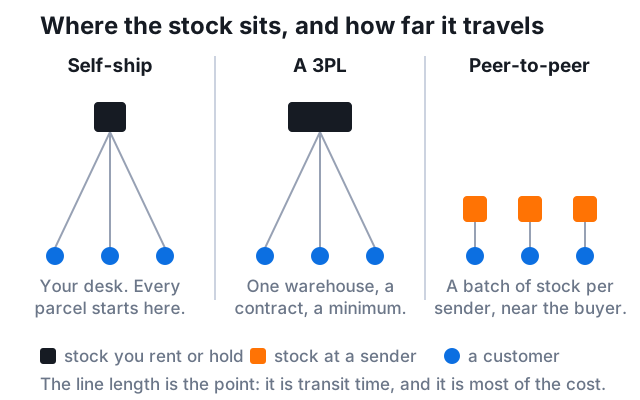
The thing that makes it a model rather than a favour is the network. One person packing for one shop is an arrangement. A pool of verified people, with the stock recorded, the label bought centrally and the money settled per shipment, is infrastructure — and that is the part that has to be built.
We run one, and we launched it this year. What it does and does not do yet is written down in we just launched a fulfilment network with no warehouse in it, including the parts that are not finished. For a Shopify store the network is reached through an app: see a Shopify fulfilment app without a warehouse.
How is it different from a 3PL, self-shipping and dropshipping?
These four are the realistic options for a small European shop, and they differ on more axes than price. The table below is the short version; the sections after it are the parts that need a paragraph.
| Self-ship | 3PL | Dropshipping | Peer-to-peer | |
|---|---|---|---|---|
| Who owns the stock | You | You | The supplier | You |
| Where it sits | Your home or office | One warehouse | The supplier’s warehouse | With one or more senders |
| Fixed cost per month | None | Storage, set-up, often a minimum | None | None |
| Minimum volume | None | Typically 100–300 orders | None | None |
| Who packs | You | Warehouse staff | The supplier | A verified individual |
| Parcel origin | Your country | The warehouse’s country | Usually outside the EU | The customer’s country |
Against self-shipping: the work leaves, the control stays
Self-shipping has no fixed cost and no minimum, which is exactly why most small shops do it. What it has instead is your evening. Twenty orders a week is about an hour of packing plus a trip, and that hour is the least valuable hour you spend on your shop.
Peer-to-peer moves that hour and nothing else. You still choose what is in the box, you still own the stock, and the packaging is still yours. What changes is that the parcel starts somewhere closer to the customer than your desk.
Against a 3PL: no building, therefore no floor
A fulfilment provider has rent, staff, warehouse software and inbound handling to pay for before it packs a single order. Those costs are spread over the orders it handles, which is why the same provider is expensive per order at 50 orders a month and cheap at 5,000.
The minimum order volume is not a policy someone chose to be difficult. It is that arithmetic, written down. Most providers in Europe start being interested somewhere between 100 and 300 orders a month, and the ones that take you below that usually have a minimum monthly invoice instead — the same constraint with a different name.
Peer-to-peer has no building underneath it, so there is nothing to spread. The cost per order is the same at 10 orders and at 200. That is the whole advantage, and it is also, exactly, why it stops being the right answer higher up: see Peer-to-peer fulfilment vs a 3PL.
Against dropshipping: it looks similar and it is not
Both models mean a parcel goes out without you touching it, and that is where the resemblance ends.
In dropshipping you do not own the stock. You pass an order to a supplier who ships it, usually from outside the EU, and you find out about problems at the same time your customer does. You do not control the packaging, the transit time, the invoice in the box, or whether the item is the one in your photos.
In peer-to-peer fulfilment you bought the stock, you shipped it somewhere, and it is yours until it is sold. The customs position is different too: your goods entered the EU once, in bulk, on your import — which since July 2026 also means one customs duty event instead of one per parcel. That sum is in the €3 EU customs duty explained, and the two models are set side by side — including the rows where dropshipping wins — in Shopify dropshipping vs peer-to-peer fulfilment.
Against a courier’s own fulfilment service
Several carriers now sell a fulfilment product alongside their delivery product. Those are warehouses with a familiar logo on them, and they behave like warehouses: storage rates, volume tiers, an onboarding process.
Worth quoting if you are near their threshold. If you are at 40 orders a month, you will get the same answer you get from an independent 3PL, in a nicer envelope.
What does peer-to-peer fulfilment cost?
Three items, and only two of them are new. The carrier rate you were paying already, whoever hands the parcel over.
| Item | What it is | Amount |
|---|---|---|
| Carrier rate | The label. Bought at network rates rather than at a single shop’s rates. | Varies by size and country |
| Sender’s fee | What the person packing your order earns. Agreed between you, by parcel size. | €1.50 – €5.50 |
| Platform fee | Ours. The same for every parcel size, and the only thing we charge a shop. | €0.85 |
| Storage | There is no warehouse to rent. | None |
| Set-up | No onboarding, no integration project. | None |
| Minimum | No monthly floor, no minimum invoice. | None |
That figure does not move with volume, and that is the point of the whole model: €3.10 is what fulfilment costs you at 10 orders a month and at 300. A warehouse quote does move — steeply — and the two lines cross somewhere. Working out where they cross for your numbers is what the vs-3PL comparison is for.
What is genuinely cheaper, and what only looks it
The saving is not primarily the packing. It is the fixed cost that is not there, and the parcel becoming a domestic one instead of a cross-border one. If your customers are all in your own country already, the second half of that saving does not apply to you.
What that second half is worth, per country and per parcel, is the subject of how to ship domestically in Europe without opening a warehouse.
How does the stock stay yours?
This is the question every shop asks second, right after the price, and it deserves a straight answer rather than a reassurance.
- The stock is recorded. What went out to whom, and what is left. A batch that has been sent is a number you can look at, not a thing you hope about.
- The people are verified. Identity checked before they can hold anything, and a payout account in their own name.
- The fee hangs on the scan. A sender earns when the parcel is scanned at the parcel point, not when they say they sent it.
- Start small. The right first batch is fifty units of one product, not your whole catalogue. That is not caution; it is how you find out what actually happens.
What this is not is insurance. Goods in someone’s house are goods in someone’s house, and a network can verify people and record stock without making that risk disappear. Price the batch accordingly, and start with a product you can afford to lose.
When is peer-to-peer fulfilment the wrong answer?
Four situations, and none of them are edge cases. If you are in one of them, the rest of this article does not apply to you.
- Small, light, non-perishable products. Tens to a few hundred units per batch.
- Uneven or seasonal volume. You pay per shipment, so a quiet month costs nothing.
- Selling into a country where you do not want to rent anything yet.
- A narrow catalogue: a handful of SKUs that make up most of your orders.
- Large, heavy or bulky goods. A parcel point will refuse them and a living room cannot hold them.
- Chilled, perishable, licensed, age-restricted or otherwise regulated goods. That needs a warehouse with the right permits, and no verification of a person substitutes for one.
- A wide catalogue. Hundreds of SKUs spread over private homes is not a network, it is a lost inventory.
- Above roughly 500 orders a month. At that volume a 3PL’s fixed costs are spread thin enough to beat this, and it should.
- Same-day dispatch promises or fixed collection windows. Someone dropping parcels on their own schedule cannot guarantee a cut-off time.
The fourth red line is the one people argue with, so it is worth being blunt about it. This model has no fixed costs and therefore no economies of scale. A 3PL has both. Above a few hundred orders a month, "no economies of scale" stops being a feature and starts being the reason you are overpaying.
If you are near that line, the honest comparison is against real quotes rather than against a claim. Eight European providers, with the minimum each one actually publishes, are in EU fulfilment without minimum orders compared.
How do you test it with one box?
The failure mode with any fulfilment change is committing to it before you know your own numbers. This is the version that costs you one batch and one month.
Pick one product and one country
Your best seller, and the market where you have the most orders after your own. One product means one number to compare afterwards, and a mistake costs you fifty units rather than your catalogue.
Work out your cost per order today
Your current label rate, plus your packing time at a rate you would actually pay someone. Most shops have never written this down, and it is the only figure that makes the comparison mean anything.
Send one batch
Enough for roughly a month of orders in that country. One shipment, one customs event if it crosses a border, and a number you can watch go down.
Run it for a month without changing anything else
Same product photos, same prices, same shipping promise on your site. If you change three things at once you will not know which one moved your numbers.
Compare four things, not one
Cost per order, transit time to the customer, your own hours, and the return rate. A model that saves you a euro and adds two days is not cheaper, it just moved the cost somewhere you do not have an invoice for.
Then decide what scale to test
If it worked, the next question is not "everything" but "which second product, or which second country". If it did not, you have lost one batch and learned your real cost per order — which you needed anyway.
Frequently asked questions
What is peer-to-peer fulfilment?
Peer-to-peer fulfilment is a way of shipping online orders in which a verified individual near your customers holds a batch of your stock at home, packs each order and drops it at a parcel point — instead of a warehouse doing it. There is no building to rent, so there is no storage fee and no minimum order volume; you pay per shipment.
How is peer-to-peer fulfilment different from dropshipping?
You own the stock. In dropshipping the supplier owns it and ships it, usually from outside the EU, and you control neither the packaging nor the transit time. In peer-to-peer fulfilment you bought the goods, you shipped them to a location you chose, and they remain yours until they are sold.
Is it cheaper than a 3PL?
Below roughly 100–200 orders a month it usually is, because a 3PL has fixed costs to spread and this has none. Above a few hundred orders a month the 3PL wins for exactly the same reason. The crossing point depends on the storage and set-up figures in your own quote.
Is my stock insured while someone else holds it?
No. Verification and stock records reduce the risk of the wrong person holding your goods; they do not insure the goods. Start with a batch you could afford to write off, and check whether your own business insurance covers stock held off your premises.
Do I need a VAT registration in the country where my stock sits?
Generally yes, and there is no threshold for it: holding stock in a country makes your sales from that stock domestic supplies there. OSS does not remove that obligation. The detail is in our article on VAT when you store stock in another EU country.
What kinds of products does it not work for?
Large, heavy or bulky items that a parcel point will not take; chilled, perishable, age-restricted or otherwise regulated goods; and wide catalogues with hundreds of SKUs. Small, light, non-perishable products with a narrow range are the fit.
How many orders a month do I need before it is worth it?
There is no minimum, which is the point — one order a month costs you the same per order as three hundred. The more useful question is the ceiling: above roughly 500 orders a month you should be getting quotes from warehouses instead.
Sources
- European Commission — removal of the €150 customs duty exemption threshold in 2026
- European Commission — One Stop Shop, the Union and Import schemes explained
- GS-Fulfilment — fulfilment for small shops, on minimum volume
- Omnipack — the parcel volume at which fulfilment starts to pay off
- Fulfilment.nl — published tiers and the minimum monthly invoice
A warehouse is not expensive because of the packing. It is expensive because it exists whether your orders arrive or not.
See where there is a domestic service today, and what it costs
Where we are active