In short
- There is no route with zero customs charges if the goods start outside the EU. There is only a choice about who pays, when, and how often.
- Delivered duty unpaid is the cheapest to set up and the most expensive in refused parcels and support tickets.
- DDP fixes the customer experience but adds a broker fee per parcel on top of the €3 per product type.
- IOSS handles the VAT cleanly and does nothing about duty. Since July 2026 that is the gap that hurts.
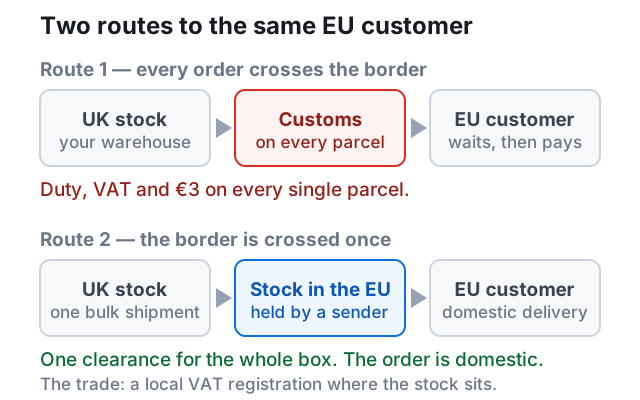
- Holding stock inside the EU removes the per-order charge entirely, because the border is crossed once instead of every day.
- That fourth route costs you a local VAT registration and only pays off above a steady weekly volume. Below that, stay on IOSS.
Since 1 July 2026 the customs duty relief for consignments under €150 no longer exists. Every low-value import into the EU now carries €3 per product type in the parcel, charged to the seller.
That has turned a question about delivery experience into a question about margin. This article compares the four routes to an EU consumer, with what each costs, what it fixes, and where it is the wrong answer.
We run one of those four routes, so read the last section — the one about where we lose — as part of the comparison rather than as a disclaimer at the end.
General information, not tax or customs advice
Duty, VAT and classification depend on your goods and your setup. Check with a customs broker or a tax adviser before you act on any of it.
The four routes at a glance
| Duty unpaid (DAP) | DDP | IOSS | Stock in the EU | |
|---|---|---|---|---|
| Who pays at the door | Your customer | Nobody | Nobody | Nobody |
| How VAT is handled | Collected on delivery | You pay it up front | Charged at your checkout | Local VAT on a domestic sale |
| Duty per order | €3 per product type | €3 per product type | €3 per product type | None — no import per order |
| Extra cost per parcel | None to you | Broker or carrier DDP fee | None | Domestic label plus a fulfilment fee |
| Fixed cost | None | None to low | IOSS registration, intermediary | Local VAT registration |
| Delivery time | Cross-border, plus clearance | Cross-border | Cross-border | Domestic |
| Refused parcels | Common | Rare | Rare | Rare |
They are not mutually exclusive. Running DDP on top of IOSS is normal, and holding stock in one EU country does not stop you from using IOSS for everything else.
Route 1 — deliver duty unpaid and let the customer settle it
You ship as you always did, the carrier presents the VAT and its own handling fee at the door, and the customer pays before the parcel is handed over.
It costs you nothing to set up, which is its only real advantage. The handling fee is typically several euros and it lands on a customer who was not expecting it.
Where it wins
Low volume to the EU, high-value orders, or a B2B customer who clears goods routinely and does not blink at a customs form.
Where it loses
Consumer orders under about €50. The handling fee is a large fraction of the order, the parcel gets refused, and you pay the return leg plus a support conversation. Your review score pays the rest.
Route 2 — DDP, so nothing arrives at the door
Delivered duty paid means you pay the VAT and the duty up front through your carrier or broker, and the parcel arrives with nothing owing.
The customer experience is clean, which is why most established cross-border sellers moved to it. The cost is a DDP or brokerage fee per parcel, on top of the €3 per product type.
Where it wins
Mid to high order values where a few euros of brokerage disappears in the margin, and any shop that cannot afford refused deliveries.
Where it loses
Small, frequent orders. You are paying a per-parcel fee and a per-product-type duty on a parcel that might be worth €20. It is the tidiest way to lose money on every order.
Route 3 — IOSS, which solves VAT and not duty
The Import One Stop Shop lets you charge EU VAT at your own checkout on consignments with an intrinsic value up to €150, and report it through a single monthly return.
It is a genuinely good scheme and it is not going anywhere. What it never covered is customs duty, and until July 2026 that did not matter below €150.
Now it does. IOSS gets your VAT right and leaves the €3 per product type exactly where it was — on your invoice from the carrier.
Where it wins
Almost every non-EU seller doing meaningful consumer volume should be on IOSS regardless of what else they do. It is the baseline, not the strategy.
Where it loses
It does not touch the duty, and it does nothing for delivery time. A parcel from the UK to Spain is still a cross-border parcel with a customs step in it.
How the two schemes differ, and why neither removes a registration that comes from holding stock, is set out in VAT when you store stock in another EU country.
Route 4 — hold the stock inside the EU
You send one bulk shipment into the EU, clear it once, and every order after that ships domestically from stock that is already there.
There is no import on the order, so there is no €3 and no per-parcel brokerage. There is also no cross-border transit time.
The classic version of this is renting space at a 3PL, which needs a minimum volume and a contract. The version we run is smaller: someone near your customers holds a batch at home, packs the orders and drops them at a service point.
Either way the customs picture is the same. What differs is the fixed cost underneath, and that is the whole break-even question.
Where it wins
Steady weekly volume into one or two EU countries, small and light products, and an average order value low enough that €3 to €9 of duty per order is material.
Where it loses
Three cases, and they are not rare.
- Low or irregular volume. A VAT registration is a fixed annual cost in administration. Under a handful of parcels a week to one country, IOSS plus the €3 is simply cheaper.
- A wide catalogue. Stock in one place means choosing which products go there. If your orders pull from two hundred SKUs, you will be splitting orders and shipping cross-border anyway.
- Large, heavy, chilled or licensed goods. This route needs a place to put the stock. Beyond a certain size that place is a warehouse, and a warehouse has its own minimums.
- Where it does fit: a focused range of small products, a market you sell into every week, and a customer who cares about delivery time.
The number that decides it is the break-even between a fixed registration cost and a per-order charge. That sum, with a chart and a calculator, is in IOSS versus holding stock in the EU.
How do you actually move to route 4?
Pick one country, not a strategy
Take the EU country you already send the most parcels to. One country is one registration and one decision; a European rollout is a project you will not finish.
Run the break-even on that country alone
Parcels a month, product types per parcel, current label cost, and what a registration plus a fiscal representative costs you per year. If the gap is small, stay where you are.
Arrange the VAT registration before the stock moves
For a non-EU business that means a fiscal representative and usually a deposit, and several weeks rather than several days. Moving stock first is the common and expensive mistake.
Send one bulk shipment of your best sellers
Not half your catalogue. Enough of your top items to cover a few weeks, cleared once, so you find out what the real handling looks like before you commit inventory.
Route only that country's orders to the local stock
Everything else keeps going out the way it always did. You are comparing two live routes on your own numbers rather than on anyone's table.
Re-check after one full month
Cost per order, delivery days, and returns. If the local route is not clearly better on at least two of those three, the honest answer is that IOSS was fine for you.
Which route should you be on?
| Your situation | Route that usually fits |
|---|---|
| A few EU orders a month, high value | Duty unpaid, or DDP if refusals hurt |
| Regular EU orders, average order above €60 | IOSS plus DDP |
| Regular EU orders, average order under €30 | IOSS now, stock in the EU as soon as volume is steady |
| Weekly volume into one EU country, small products | Stock in that country |
| Wide catalogue, unpredictable mix | IOSS plus DDP — local stock will fragment your orders |
| Large, heavy or licensed goods | A 3PL with the right permits, not any of the above |
Frequently asked questions
Is there a way to sell into the EU with no customs charges at all?
Not if the goods start outside the EU. Every import carries €3 per product type since July 2026. The only way the charge disappears per order is to import once in bulk and ship domestically from stock already inside the EU.
Does IOSS remove the €3 customs charge?
No. IOSS is a VAT scheme for consignments up to €150 of intrinsic value. Customs duty is separate, and the €3 per product type applies regardless of whether you use IOSS.
What is the difference between DDP and IOSS?
IOSS is how you report and remit the VAT; DDP is a shipping term that means you have paid everything due before delivery. Most sellers use both: IOSS for the VAT, DDP so nothing is collected at the door.
Do I need a VAT number in every EU country I sell to?
No — that is what OSS is for. You need a local VAT number in each country where you hold stock, which is a different obligation and has no threshold.
Can I hold stock in the EU and keep using IOSS?
Yes. They cover different things. Orders shipped from EU stock are domestic or intra-EU supplies; anything you still import stays under IOSS.
How long does it take to set up EU stock?
The VAT registration is the long pole: days to a few weeks inside the EU, several weeks for a non-EU business appointing a fiscal representative. Getting the stock there is a normal shipment.
At what volume does holding stock in the EU pay off?
It depends on your fixed cost and your product types per parcel. On the assumptions in our break-even article it is around seventy parcels a month to a single country — run it on your own numbers before deciding.
Sources
There is no route without customs. There is only a choice between paying at the border every day and paying at the border once.
See which EU countries have a domestic service today
Where we are active