In short
- AirPost is a peer-to-peer fulfilment network: a verified person near your customers holds a batch of your stock at home, packs your orders and drops them at a parcel point. There is no warehouse, so there is no storage fee and no minimum order volume.
- We built it for the gap under a 3PL: most fulfilment providers in Europe want 100 to 300 orders a month, and a shop doing 40 has nowhere to go but its own kitchen table.
- A shop pays the carrier rate, a sender's fee of €1.50 to €5.50 by parcel size, and our €0.85 platform fee. Nothing else, and nothing monthly.
- Shipping originates from 8 countries today. Which of those has a domestic service, and at what rate, comes from the live rate card rather than from this article.
- What does not work yet: there is no Shopify or WooCommerce integration, so orders are set up by hand. In many regions there is no sender near your customers yet.
- It is not insurance. Stock in someone’s home is stock in someone’s home, and no amount of verification changes that.
- We are one person with a KVK number in Urk, not a logistics group. That is relevant to how fast some of the above will change.
AirPost is live. This article is the honest version of what that means: why it exists, how an order actually runs through it, what works today, and the list of things that do not.
We are writing that last part down deliberately. A new platform that only lists what it can do is asking you to find out the rest at your own expense, and you would be right to distrust it.
Why build a fulfilment network with no warehouse?
Fulfilment in Europe has a floor. Providers generally start being interested somewhere between 100 and 300 orders a month, and below that the arithmetic does not work for either side: their rent, staff and warehouse software are spread over too few orders to make an offer worth signing.
The ones that do take small shops mostly move the floor rather than remove it. A minimum monthly invoice, a set-up fee amortised over your first year, or storage priced per pallet all have the same effect on your cost per order as an order minimum does.
Meanwhile the average small European shop sits well under that line — tens of orders a month, packed in the evening by the person who also does everything else. That shop is not badly served by fulfilment; it is not served at all.
The reason is fixed costs, and fixed costs come from the building. So we built the version with no building: the stock sits with people who already live where your customers are, and the parcel starts there. The model, and where it breaks, is in what is peer-to-peer fulfilment.
How does an order actually run?
You send a batch of stock to a sender
One shipment, not one per order. Enough for roughly a month of orders in that country. If it crosses a border it clears customs once, for the whole batch.
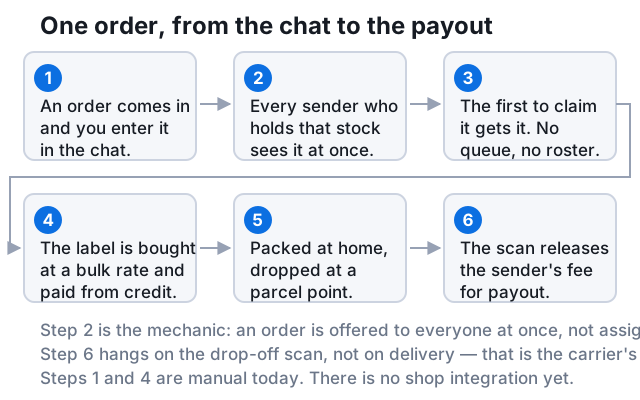
An order comes in and you enter it
By hand today, in the chat with your sender. This is the step an integration will remove, and it has not been built yet.
Everyone holding that stock sees it at once
Not a queue and not a roster. The order is offered to every sender who has your goods and has room, and the first to claim it gets it.
The label is bought at network rates
Paid from the shop’s credit balance, at rates bought across the whole network rather than by one shop on its own.
It is packed at home and dropped at a parcel point
On a trip the sender was making anyway. The parcel starts in the customer’s own country, so it is a domestic parcel with a domestic transit time.
The scan releases the sender’s fee
Their fee hangs on the drop-off scan, not on delivery — delivery is the carrier’s responsibility. Payouts run with a short hold, and we withhold our commission there.
What works today, and what does not?
The table below is the whole answer. There is no roadmap column, because a date we have not committed to is not information.
| Today | |
|---|---|
| Sending a batch of stock to a sender | Works |
| Buying a label at network rates | Works |
| Rates per carrier, size and destination, up front | Works |
| Parcel point drop-off and tracking | Works |
| Paying per shipment, with no monthly cost | Works |
| Sender verification and payouts | Works |
| Site and app in English as well as Dutch | Works |
| Entering an order | By hand, in the chat |
| Shopify, WooCommerce, Lightspeed, bol.com, Amazon | Not yet |
| A sender near every customer | Not yet — depends on the region |
| Same-day dispatch or a fixed collection window | Not offered |
| Insurance on stock held at a sender | Not offered |
- There is no shop integration. Orders are set up by hand in the chat, which is fine at 30 orders a month and irritating at 300.
- We have just started. In a lot of regions there is no sender holding stock near your customers yet, and the answer to "can you ship in my area" is sometimes simply no.
- It is not insurance. Verification and stock records reduce the chance of the wrong person holding your goods; they do not compensate you if something happens to them.
- It is the wrong model for large, heavy, chilled or regulated goods, and for catalogues with hundreds of SKUs.
- Above a few hundred orders a month a 3PL will beat us on cost per order, and we would rather say so here than in an invoice.
- What is real: no minimum, no storage cost, no set-up cost, no contract, and a price per shipment you can see before you order anything.
Countries you can ship from
8
Orders a month — there is no minimum
from 1
Our fee per shipment, every size
€0.85
There is no sender count or parcel count in that row, and that is on purpose. Those are numbers a young platform is tempted to round up, and a number you cannot check is worth less than no number. What is on the site instead is measured: the rate card, the countries, and the senders who are actually listed.
What does it cost?
| Item | What it is | Amount |
|---|---|---|
| Carrier rate | The label, bought at network rates and shown before you order. | By size and destination |
| Sender’s fee | What the person packing your order earns. Agreed between you. | €1.50 – €5.50 |
| Platform fee | Ours. The same for every parcel size. | €0.85 |
| Subscription | There isn’t one. | None |
| Set-up, storage, minimum | There is no warehouse and no contract underneath this. | None |
On the other side, a sender is paid their fee and we withhold 3% commission when they cash out. That is our second revenue line, and it is the reason the platform fee can stay at €0.85 instead of climbing.
Whether that beats a warehouse quote at your volume is arithmetic rather than opinion, and you can run it yourself in peer-to-peer fulfilment vs a 3PL.
Who is behind it?
AirPost is a sole trader registered with the Dutch Chamber of Commerce under number 92154220, based in Urk, the Netherlands. The site is airpost.network and support runs through support@airpost.network.
That is worth stating plainly rather than dressing up, because it tells you something useful about the list of things that do not work yet. A shop integration is a quarter of work, not a sprint, and knowing who you are dealing with is how you judge whether to wait for it.
What we will not do
We will not publish a sender count until it is worth publishing, we will not quote a competitor’s price we cannot link to, and we will not put a delivery promise on the site that depends on someone else’s trip to the shops. Those three rules are why some pages here say less than you would expect.
How do you start?
Check whether there is a domestic service where you sell
The countries page reads the live rate card. If your market is not on it, this is not for you yet, and that is a two-minute answer rather than a sales call.
Work out your cost per order today
Your current label rate plus your own packing time at a rate you would pay someone else. Without that figure you cannot tell whether anything below is an improvement.
Find a sender and agree a fee
Senders list their price per parcel size, their capacity and the carriers they use. You pick; nobody is assigned to you.
Send one batch of one product
Your best seller, enough for about a month of orders in that country. One product, so that afterwards you have one number to compare.
Run it for a month and compare four things
Cost per order, transit time, your own hours, and the return rate. A model that saves a euro and adds two days has not saved you anything.
Frequently asked questions
What is AirPost?
AirPost is a peer-to-peer fulfilment network for small online shops in Europe. A verified person near your customers holds a batch of your stock at home, packs your orders and drops them at a parcel point, so the parcel is a domestic one. There is no warehouse, therefore no storage fee and no minimum order volume.
What does AirPost cost?
The carrier rate for the label, a sender's fee of roughly €1.50 to €5.50 depending on parcel size, and a €0.85 platform fee per shipment. There is no subscription, no set-up cost, no storage cost and no minimum. Fulfilment for a small parcel comes to about €3.10 plus the label.
Does it work with Shopify, WooCommerce or Amazon?
Not automatically yet. In this version you set your orders up by hand in the chat with your sender. Integrations are the next thing after that, and we have not committed to a date.
Which countries can you ship from?
Shipping originates from 8 countries. Which of those has a domestic service today, and at what rate, is on the countries page — that reads the live rate card, and it is a more honest answer than a list written into an article.
Is my stock safe with a stranger?
Senders are identity-verified before they can hold anything, stock is recorded, and a sender’s fee is only released once the parcel is scanned at the parcel point. None of that is insurance. Start with a batch you could afford to write off.
How many orders do I need?
One. There is no minimum, because there is no fixed cost to cover. The more useful limit is at the other end: above roughly 500 orders a month a warehouse will be cheaper per order than we are.
Who runs it?
AirPost, a Dutch sole trader registered with the Chamber of Commerce under number 92154220 in Urk. Support is at support@airpost.network.
Sources
- Omnipack — the parcel volume at which outsourcing fulfilment starts to pay off
- Fulfilment.nl — published tiers and the €500 minimum monthly invoice
- GS-Fulfilment — fulfilment for small shops, on minimum volume
- European Commission — removal of the €150 customs duty exemption threshold in 2026
- KVK — the Dutch business register
A launch post that lists only what works is not a launch post. It is a brochure with a date on it.
See which countries have a domestic service today, and what it costs
Where we are active