In short
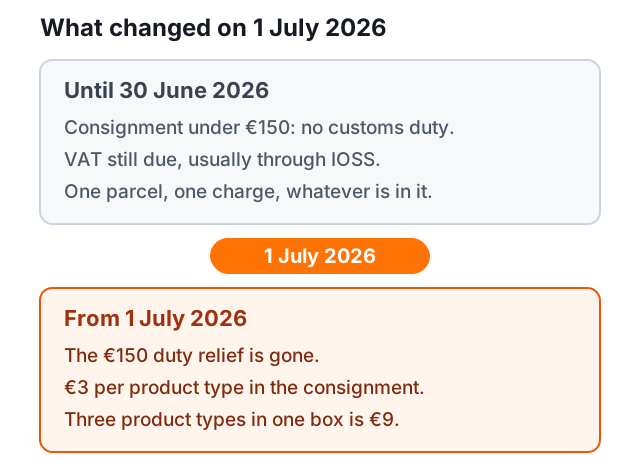
- From 1 July 2026 the customs duty relief for consignments of €150 or less no longer exists.
- In its place there is a flat €3 charge — per product type in the consignment, not per parcel.
- A parcel with three different product types therefore costs €9, and a five-item bundle costs €15.
- It is charged to the seller, importer or their representative. Your customer does not see it; your margin does.
- It is separate from VAT. IOSS still handles the VAT on consignments up to €150 and that has not changed.
- It is a transitional measure until the EU customs data hub arrives, expected in 2028, after which normal tariff rates apply.
- Goods already inside the EU are not affected at all — which is the whole point of holding stock there.
For years the sum for a UK seller shipping to an EU consumer was simple enough: keep the consignment under €150, register for IOSS, charge VAT at the checkout, and no duty applies.
The second half of that sentence stopped being true on 1 July 2026. The duty relief for low-value consignments has been abolished, and a flat charge took its place.
This article sets out exactly what that charge is, how it is counted, what it costs on a real order, and what it does not apply to. No advice, just the arithmetic and the sources.
What exactly changed on 1 July 2026?
The EU abolished the duty relief for consignments with an intrinsic value of €150 or less. That relief was the reason a €40 parcel from outside the EU arrived without any customs duty.
In its place there is a flat customs duty of €3 on qualifying low-value consignments sold at distance to EU consumers. It is an interim measure, meant to run until the EU customs data hub for e-commerce comes online — expected in 2028.
After that, normal customs duty applies: each product classified under its own tariff heading, at its own rate. The €3 is the simple version that buys the customs union time.
General information, not customs advice
Classification and duty are specific to your goods and your arrangement. Check with your customs broker or your national customs authority before you act on any of it.
Why is a three-item parcel €9 and not €3?
This is where almost everyone reads it wrong. The €3 is charged per product type in the consignment, not per consignment.
"Product type" means tariff heading: the category a product falls under in the customs nomenclature. Two T-shirts in different colours are one heading. A T-shirt and a cap are two.
| What is in the parcel | Product types | Charge | On a €25 order |
|---|---|---|---|
| One T-shirt | 1 | €3 | 12% of the order value |
| Two T-shirts, different colours | 1 | €3 | 12% |
| A T-shirt and a cap | 2 | €6 | 24% |
| A three-product skincare set | 3 | €9 | 36% |
| A five-product bundle | 5 | €15 | 60% |
That has an uncomfortable consequence: the bundle you built to raise your average order value is now the most expensive thing you ship.
Splitting the bundle across two parcels does not help either — you then pay €3 per product type in each of them, plus a second shipping label.
What counts as one product type?
A tariff heading, in the customs nomenclature. It is a category of goods rather than a stock keeping unit, which is why the count is usually lower than your SKU count and higher than one.
The rule of thumb that gets you most of the way: variants of the same thing are one heading, different kinds of thing are two.
| Two items in one parcel | One product type or two? | Why |
|---|---|---|
| Two T-shirts, different sizes | One | Same kind of garment, same heading |
| Two T-shirts, different colours | One | Colour is a variant, not a category |
| A T-shirt and a hoodie | Usually two | Different garment categories |
| A T-shirt and a cap | Two | Clothing and headwear are separate headings |
| A face cream and a face serum | Usually one | Both are skin-care preparations |
| A face cream and a lipstick | Two | Skin care and lip make-up are separate |
| A candle and a candle holder | Two | A wax article and a household article |
The practical consequence is that a shop with one deep category pays far less than a shop with a broad one, even at the same order value.
It is worth knowing your real count before you decide anything. Most sellers guess low.
Who pays it, you or your customer?
You do. The charge falls on the seller, the importer or their representative, not on the consumer at the door.
That is good news for your delivery experience and bad news for your margin. There is no angry customer refusing a parcel over an unexpected fee; there is a line on your own costs that was not there in June.
It also means it does not show up in any of your customer-facing numbers. You will find it in your carrier or broker invoice, after the sale.
What does it do to your margin?
Take a €25 order with a 40% gross margin — €10 before shipping. Now put the charge next to it.
| Product types in the parcel | Charge | Gross margin left on a €25 order | What is left after €6 shipping |
|---|---|---|---|
| 1 | €3 | €7.00 | €1.00 |
| 2 | €6 | €4.00 | −€2.00 |
| 3 | €9 | €1.00 | −€5.00 |
| 5 | €15 | −€5.00 | −€11.00 |
The row that matters is the second one. Two product types in a parcel is not an edge case — it is a normal order for most shops, and at a €25 average order value it is already under water.
Sellers with a €60 or €80 average order value feel it much less. If your average order is under €30 and you ship from outside the EU, this is a structural problem rather than a nuisance.
What is not affected?
- Goods already inside the EU. An order shipped from stock you hold in an EU country is a domestic or intra-EU supply, and no import duty arises on it.
- The IOSS VAT scheme itself. The €150 intrinsic-value limit for IOSS still exists and works the same way.
- B2B shipments and consignments above €150, which were already subject to normal customs duty.
- Shipping and insurance do not count towards the €150 intrinsic value — but they also do not get you out of the €3.
- Splitting an order into two parcels does not reduce the total charge, and it adds a label.
The first line is the one with a strategy attached to it. It is why "hold the stock inside the EU" went from a delivery-time argument to a cost argument in a single afternoon.
What are your options?
There are four, and they are compared honestly — including where each one loses — in Selling to the EU without customs charges. In short:
- Absorb it. Simplest, and fine if your average order value is high enough that €3 to €9 disappears in the margin.
- Raise your EU prices. Works if your category tolerates it, and it makes you visibly more expensive than an EU-based competitor.
- Consolidate your bundles. Fewer tariff headings per parcel is genuinely fewer charges. It is a product decision, not a shipping one.
- Hold stock inside the EU. The charge disappears entirely, and you buy a domestic delivery time. The price is a local VAT registration.
The fourth option is not free, and the honest version of the sum — including at what volume it stops being worth it — is in IOSS versus holding stock in the EU.
What the VAT registration itself involves, and why OSS does not remove it, is in VAT when you store stock in another EU country.
What should you do this month?
Count product types, not parcels
Pull one real month of EU orders and count the distinct tariff headings per order. That number times €3 is your new monthly cost line, and it is almost always higher than people guess.
Check your carrier or broker invoice
The charge lands there, not at your checkout. If you have not seen it yet, you have not seen your real cost per EU order since July.
Recalculate your EU margin per order, not per month
A monthly average hides that your small orders are now loss-making while your large ones are fine. The decision you need to make is per order band.
Look at your bundles
A bundle of five different products carries €15. Reducing the number of tariff headings per parcel is the only lever that works without changing where your stock sits.
Compare against holding stock in the EU
One VAT registration against €3 per product type on every order. Run the break-even before you assume either answer.
Frequently asked questions
How much is the EU customs charge on a low-value parcel?
€3 per product type in the consignment, since 1 July 2026. A parcel with one product type costs €3, one with three product types costs €9.
Is the €3 charged per parcel or per item?
Neither exactly: it is per product type, meaning per tariff heading. Two identical T-shirts are one product type and cost €3 together; a T-shirt and a cap are two and cost €6.
Who pays the €3, the seller or the customer?
The seller, the importer or their representative. It is not collected from the consumer on delivery, so it lands in your margin rather than in your customer experience.
Does the €150 threshold still exist?
For VAT under IOSS, yes: consignments with an intrinsic value up to €150 still use that scheme. What disappeared on 1 July 2026 is the customs duty relief that used to sit alongside it.
Does the charge apply to stock I already hold inside the EU?
No. It applies to goods imported into the EU. Once stock is inside the EU, an order shipped from it is a domestic or intra-EU supply and carries no import duty.
How long will the €3 charge last?
It is a transitional measure until the EU customs data hub for e-commerce is operational, expected in 2028. After that, normal customs duty by tariff classification is expected to apply.
Does shipping count towards the €150?
No. Intrinsic value is the price of the goods alone, excluding shipping and insurance. A €140 order with €15 postage is still a low-value consignment.
Sources
The number that matters is not €3. It is €3 times the number of different things you put in the box.
See what a domestic parcel costs inside the EU
Where we are active