In short
- A domestic parcel and a cross-border parcel are not the same product. The domestic one is cheaper, faster, and has no customs step in it.
- Since July 2026 an import into the EU also carries €3 of customs duty per product type in the parcel, so a three-item order is €9 and not €3.
- You do not need a warehouse to make your parcels domestic. You need stock inside the country, and that can sit with a person.
- Holding stock in a country generally makes you liable to register for VAT there, with no threshold. OSS does not remove that.
- Which countries have a domestic service today, and at what rate, comes from the live rate card below rather than from this article.
- Fulfilment on a domestic parcel is a sender's fee plus our €0.85 platform fee — around €3.10 — with the domestic carrier rate on top.
- Test it with one product, one country and one month before you commit anything.
Most small European shops sell to more than one country and ship from exactly one. Every order to Germany, France or Spain leaves the same shelf, crosses the same border, and arrives two to four days after a German competitor’s would have.
The usual answer to that is a warehouse in each market, which is why the usual answer is also "not yet". This article is about the version that does not need one.
Why is a domestic parcel not the same as a cross-border one?
A parcel that starts in the customer’s own country is a different product from one that reaches them across a border, and it differs on three things at once.
- Transit. Domestic networks run overnight or next-day as standard. A cross-border parcel goes through a hand-off between two networks, and that hand-off is where the extra days live.
- Price. Domestic rates are the volume product of every carrier in Europe. Cross-border is a smaller, dearer stream, and it carries surcharges the domestic one does not.
- Customs. Between EU countries there is no customs step, but from outside the EU there is one on every single parcel — and since July 2026 that step has a duty attached to it.
That third point is the one that changed recently and the one most sellers have not priced in. The €150 duty exemption is gone, and the replacement is a flat €3 of customs duty per product type in the parcel. A parcel with three different items in it carries €9, not €3. The full mechanic is in the €3 EU customs duty explained.
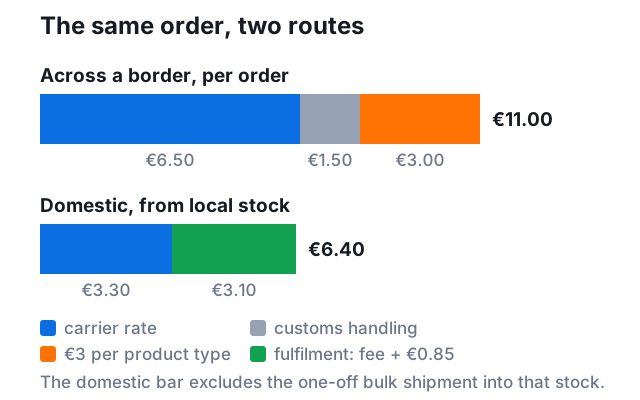
That last caveat is the whole break-even. One bulk shipment has a fixed cost; per-parcel importing does not. Which of the two wins depends on your volume, and that sum is worked through in IOSS versus holding stock in the EU.
How do you get stock into a country without renting one?
Domestic shipping needs exactly one thing: your goods, physically inside the destination country, before the order arrives. Everything else about a warehouse — the shelving, the contract, the minimum, the storage bill — is a way of achieving that, not the thing itself.
Peer-to-peer fulfilment achieves it differently. A verified person who already lives in that country holds a batch of your stock at home, packs the orders that come in, and drops them at a parcel point. The parcel is domestic because the stock was domestic. What the model is, and where it stops working, is in what is peer-to-peer fulfilment.
On the money side there is no storage bill and no minimum, because there is no building. You pay a sender's fee — €2.25 for a small parcel — plus our €0.85 platform fee, and the domestic carrier rate.
Which countries that is actually possible from today, and at what rate and transit time, is not something this article should tell you. It is a measurement, and it changes. Here it is:
Where you can ship from today, and what it costs
| Country | Transit | Letterbox parcel | Small parcel | Medium parcel |
|---|---|---|---|---|
| Austria | 1 working day | — | €7.25 | €7.25 |
| Belgium | 1 working day | — | €5.38 | €6.08 |
| France | 1 working day | — | €8.62 | €11.42 |
| Germany | 2 working days | — | €6.00 | €7.05 |
| Italy | 2 working days | — | €4.46 | €4.46 |
| Netherlands | 1 working day | €5.50 | €6.85 | €6.85 |
| Spain | 1 working day | — | €8.00 | €8.65 |
A country missing from that table is a country with no domestic service yet, not an omission. That is the honest state of a young network, and it is better read from the rate card than from a sentence.
What do you have to arrange per market?
General information, not tax advice
VAT rules and licence conditions change and depend on your situation. Check with a tax adviser or the relevant tax authority before you act on any of this.
The rule underneath all of it is the same everywhere: holding stock in a country makes your sales out of that stock domestic supplies there, and that generally means a VAT registration in that country. There is no distance-selling threshold that saves you, and the One Stop Shop does not remove the obligation either.
| Market | VAT registration when you hold stock | Import VAT | Worth knowing |
|---|---|---|---|
| Netherlands | Yes, no threshold | Deferrable to your periodic return under an Article 23 licence | The cash-flow answer, and the usual first EU landing point for a UK seller |
| Germany | Yes, no threshold | Generally paid at import and reclaimed in the return | The largest consumer market in the EU; a domestic German parcel is the cheapest one you can send a German customer |
| France | Yes, no threshold | Reverse-charged automatically since January 2022 | The deferral is built in rather than something you apply for |
| Belgium | Yes, no threshold | Deferrable with an import VAT deferment licence | Small market, short transit times to the Netherlands, France and western Germany |
| Spain | Yes, no threshold | Deferrable under the monthly-return deferral regime | Worth it if Iberia is your market; a poor hub for northern Europe |
| Austria | Yes, no threshold | Deferrable via your tax account | Reaches southern Germany quickly; small on its own |
Which of those countries is the right first one is a separate question from what each one asks of you, and it is answered in where to hold stock in Europe. The registration side in detail is in VAT when you store stock in another EU country. Three markets have their own walkthrough: Germany, France and the Netherlands and Belgium.
One thing to be blunt about: a VAT registration is a fixed cost with an accountant attached, and it is usually larger than the fulfilment saving in the first months. That is an argument for one country at a time, not for none.
How do you test one country with one box?
Pick the country you already sell into most, after your own
Not the biggest market in Europe — the biggest one in your own order history. You want a month of real orders out of this test, and that only happens where you already have demand.
Pick one product
Your best seller. One product means one number to compare afterwards, and it means a failed test costs you one batch instead of your catalogue.
Work out what that order costs you today
Your current cross-border label, any customs handling, the €3 per product type if you import from outside the EU, and your own packing time at a rate you would pay someone else.
Sort the VAT position before the stock moves
Registration first, stock second. Doing it the other way round means backdating a registration, and that is the expensive version of this step.
Send one batch, enough for about a month
One shipment. If it crosses a border it clears customs once, for the whole batch, instead of once per order.
Run it for a month without changing anything else
Same prices, same photos, same shipping promise on the site. Change three things at once and you will not know which one moved your numbers.
Compare four things and then decide on the second country
Cost per order, transit time, your own hours, and the return rate. If it worked, the next question is which second country — not whether to move everything.
Where does this stop working?
- Small, light, non-perishable products with a narrow range.
- A market where you already have orders, so a month of testing produces data.
- Volume that is uneven or seasonal — you pay per shipment, so a quiet month costs nothing.
- A country where the registration and adviser cost more than a year of your fulfilment saving. Do the sum before the stock moves.
- Large, heavy, chilled, perishable or regulated goods. A parcel point will refuse them and a home cannot hold them.
- Hundreds of SKUs. Splitting a wide catalogue over private homes is not local fulfilment, it is lost stock.
- A same-day cut-off or a guaranteed collection window. Someone dropping parcels on their own schedule cannot promise a time.
- A country with no domestic service in the table above. That is a no today, not a maybe.
Frequently asked questions
Can I ship domestically in another EU country without a warehouse there?
Yes. What makes a parcel domestic is that the goods are physically in that country when the order arrives, not that they sit in a warehouse. Stock held by a verified person in that country produces the same domestic parcel, at the domestic rate and the domestic transit time.
Do I need a VAT number in a country where I hold stock?
Generally yes, and there is no threshold. Holding stock there makes your sales from that stock domestic supplies in that country, and the One Stop Shop does not remove the obligation. A non-EU business usually also needs a fiscal representative.
How much cheaper is a domestic parcel than a cross-border one?
It varies by country and size, but the gap is rarely small: domestic rates are every carrier’s volume product, cross-border is a smaller and dearer stream with surcharges. On top of that, an import from outside the EU now carries €3 of customs duty per product type in the parcel.
How can a UK seller ship domestically inside the EU?
By getting the goods into the EU once, in bulk, and shipping from there. One import means one customs event and one set of duty for the whole batch, instead of one per parcel. The country you land the stock in then decides your VAT position.
Is this the same as dropshipping?
No. You own the stock, you bought it, and you chose where it sits. In dropshipping the supplier owns it and ships it, usually from outside the EU, and you control neither the packaging nor the transit time.
Which countries can I ship from today?
That comes from the live rate card on this page rather than from this text, because it changes. A country that is not in that table has no domestic service yet.
How much stock should I send in the first batch?
Roughly a month of orders for one product in that country. Enough to produce real data, small enough that a failed test is an annoyance rather than a write-off.
Sources
- European Commission — removal of the €150 customs duty exemption threshold in 2026
- European Commission — One Stop Shop, the Union and Import schemes explained
- Belastingdienst — VAT for foreign entrepreneurs and fiscal representation
- Grant Thornton — deferring import VAT in the Netherlands under Article 23
- eVAT — VAT deferment schemes across the European Union
You are not buying a warehouse. You are buying the fact that the parcel starts on the right side of the border.
See the domestic rate and transit time per country
Where we are active